Traffic Signal Installation: The Complete Guide to Process, Cost, and Standards
By Sadler Electric, Inc. — Omaha & Council Bluffs Traffic Signal Contractors
Traffic signal installation is a specialized infrastructure project requiring licensed specialty contractors, agency approvals, underground electrical work, drilled shaft foundations, and close coordination with state DOTs and local municipalities. A new signal at a standard four-way intersection involves multiple trades, several months of design and permitting, and a multi-week construction window with live traffic operating around the work.
This guide explains the complete process — from site preparation through final turn-over to the agency — along with cost guidance, contractor qualification requirements, and the standards that govern signal work in Nebraska and Iowa.
What Is Traffic Signal Installation?
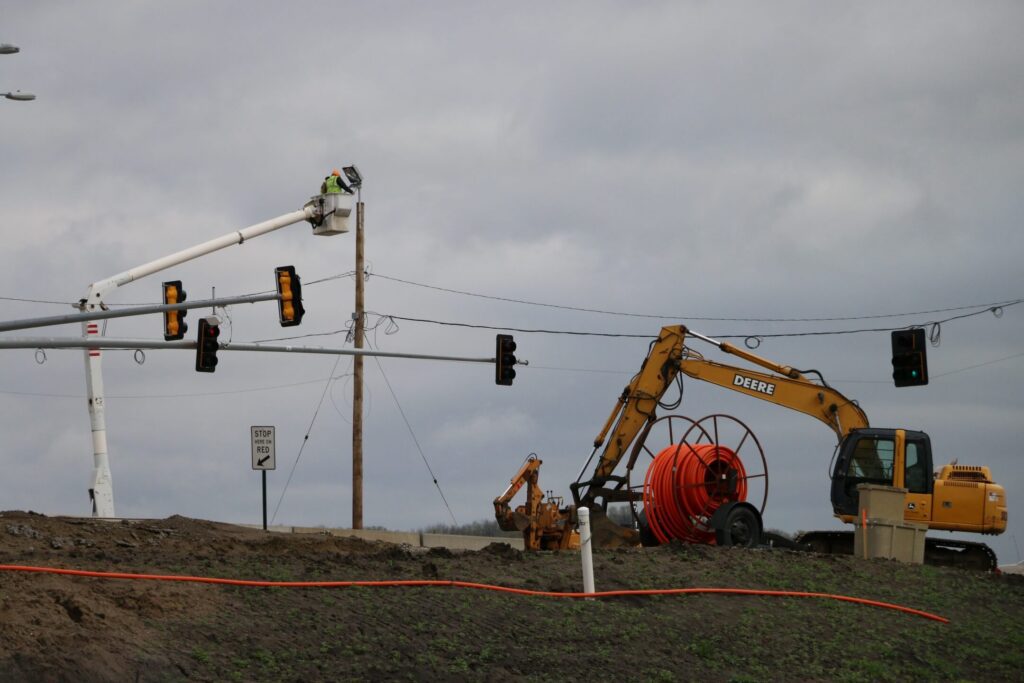
Traffic signal installation is the construction of a new traffic control signal system at an intersection or mid-block location. It includes all of the following components:
- Site preparation and traffic control during construction
- Underground conduit, pull boxes, and conductors connecting all components
- Drilled shaft foundations for signal poles and mast arms
- Signal poles and mast arm structures carrying the signal heads
- Signal head assemblies with LED modules, backplates, and pedestrian equipment
- Controller cabinet housing the signal controller, conflict monitor, and related electronics
- Electrical service from the utility company to the cabinet
- Final programming, testing, and commissioning before turn-over
Qualification rules depend on the agency, contract, and work scope. Some Iowa DOT signal specifications require an IMSA Level II signal technician, and prime-contractor prequalification can apply to many NDOT projects. Confirm the exact license, technician, bidding, and experience requirements in the project documents. Projects range from a single intersection to 50 or more intersections depending on the contract type.
Traffic Signal System Components
Understanding what is in a signal system clarifies the scope of installation work.
Signal poles and mast arms. The steel structures that carry signal heads and pedestrian equipment over the roadway. A standard signalized intersection uses mast arm poles — cantilever arms spanning across one or more approach lanes — on some or all four corners. Each pole sits on a drilled shaft foundation. Mast arm lengths range from 20 to 60 feet or more at wide urban intersections.
Signal heads. The red-yellow-green lenses and LED modules that direct vehicular traffic. A standard signal head has three sections (stop, caution, go) with optional left-turn arrow sections. Modern heads use LED modules for energy efficiency and long lamp life. Many agencies specify LED signal modules for new work and replacements. The required equipment is controlled by the applicable agency standards, plans, and contract documents; verify the approved signal-head specification.
Pedestrian signal units. The countdown pedestrian heads mounted on signal poles, with accessible push buttons at each crossing. Whether accessible pedestrian signals (APS) with audible and vibrotactile indications are included is set by the project design, the agency's standards, and the applicable accessibility requirements for the work.
Controller cabinet and signal controller. The cabinet is the weatherproof enclosure housing the signal controller (the computer that runs the timing program), the conflict monitor (a hardwired device that prevents conflicting phases from being displayed simultaneously — the safety element), phase load switches, and all field wiring terminations. Modern controllers are Type 2070 or NEMA TS2 units capable of adaptive operation, communications, and remote access.
Underground electrical system. All wiring between the cabinet and signal poles runs in buried conduit. A standard four-approach intersection requires 1,000 to 2,500 linear feet of conduit in multiple circuits, 12 to 24 pull boxes for conductor access, and the circuit conductors themselves. This is typically the largest single labor component of a signal installation.
Electrical service. The power connection from the utility company to the cabinet. In Omaha, OPPD provides service to most signals. In Council Bluffs, MidAmerican Energy serves the urban area. Service is typically 120/240V single-phase; larger signals may require 120/208V three-phase.
Underground Conduit, Pull Boxes, and Electrical Rough-In
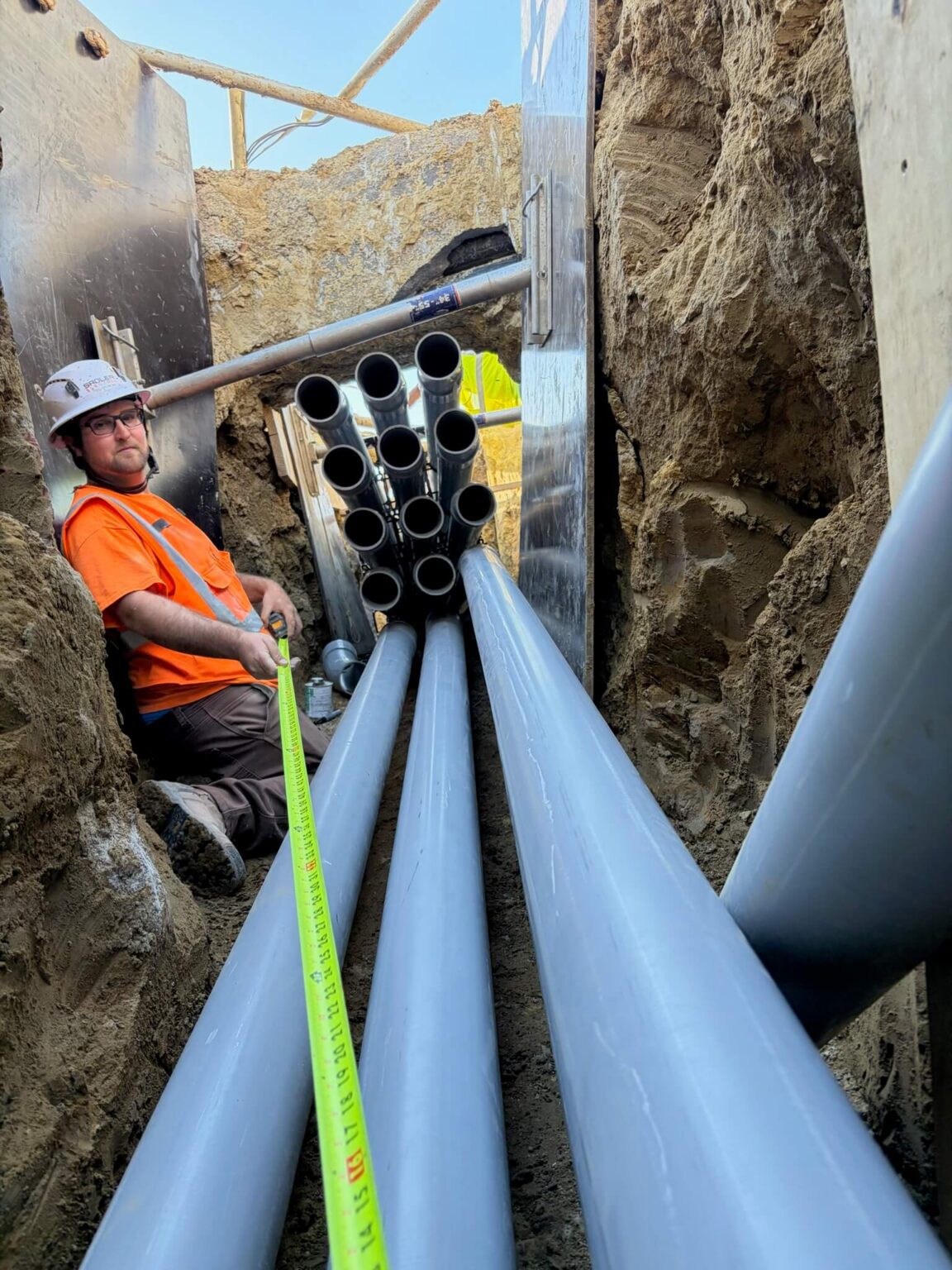
The underground electrical system is the foundation of a signal installation. All conductors run in buried PVC conduit (Schedule 40 or Schedule 80 depending on application); rigid metal conduit is used in the cabinet and where conduit rises above grade.
Conduit routing. Each signal phase, pedestrian circuit, and detection circuit runs in its own conduit. A four-phase signal with full pedestrian coverage and video detection may have 6 to 12 separate conduit runs in the intersection. Install conduit at the depth required by the adopted electrical code, roadway-owner standard, utility-crossing detail, and approved plans.
Trenching methods. Most conduit is installed by saw-cut and open-cut trench in existing pavement. In new construction, conduit is placed before paving. Before excavation, locate utilities as required by OSHA, state law, and the project. Use potholing, hydrovac, or another approved locating method when the exact location must be exposed.
Pull boxes. Pre-cast concrete or polymer junction boxes are placed at intervals along conduit runs and at all conductor splices. Boxes are sized to allow conductors to be pulled and terminated. Box locations are shown on the signal plans and become part of the as-built record.
Conductors. Traffic signal conductors are typically 14 AWG multi-conductor signal cable (Type TS or similar per NEMA standards) for control circuits and individual THW or THWN conductors for power circuits. Conductor identification and color coding follow NEMA TS-2 standards.
Traffic Signal Pole Foundations and Drilled Shaft Requirements
Signal-pole foundations are designed for the loads, soil conditions, frost considerations, and agency requirements shown in the project documents. Do not use a generic frost-depth number as a substitute for the approved structural and geotechnical design.
Foundation dimensions are designed by the pole structural engineer and shown on the pole shop drawings or the signal plans. Typical dimensions for signal work in Omaha area soils:
- Standard mast arm pole — Diameter: 30 – 36 in; Depth: 14 – 22 ft
- Large or long-span mast arm — Diameter: 36 – 48 in; Depth: 18 – 28 ft
- Pedestrian pole or small arm — Diameter: 18 – 24 in; Depth: 10 – 16 ft
Set and verify the anchor-bolt template to the tolerance stated in the approved pole shop drawings, plans, and agency specifications. Misaligned anchor bolts require costly structural repair; this is one of the most critical quality control steps in the installation.
Traffic Signal Pole and Mast Arm Installation
Erect the pole only after the concrete meets the strength and approval requirements in the project documents.
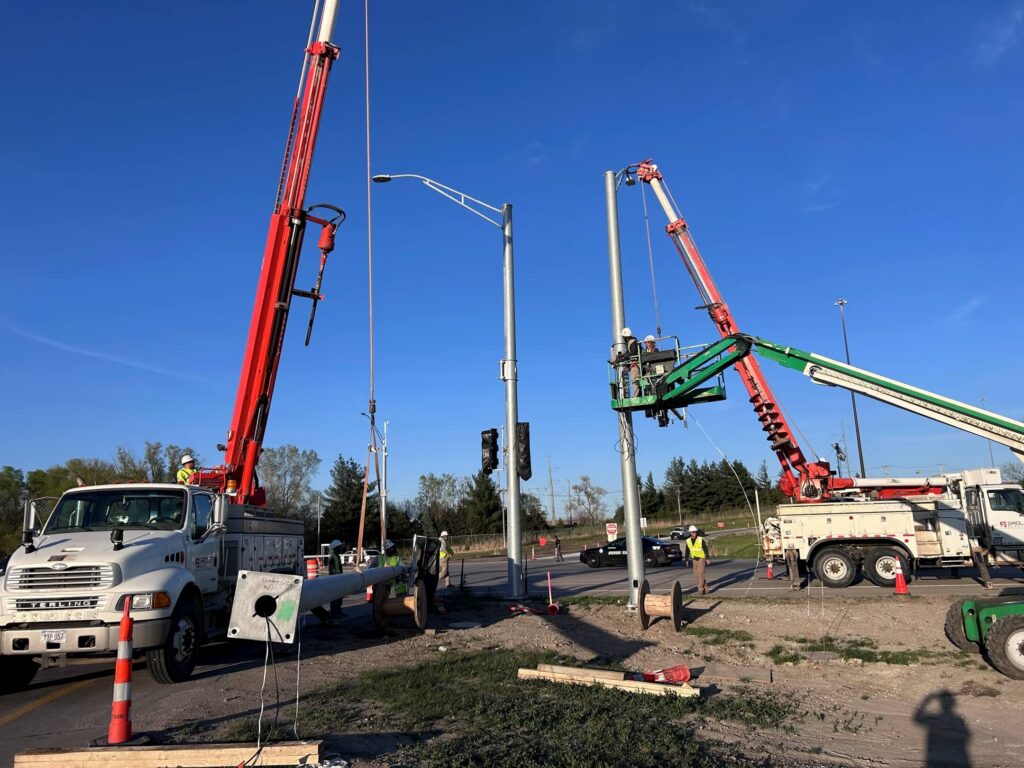
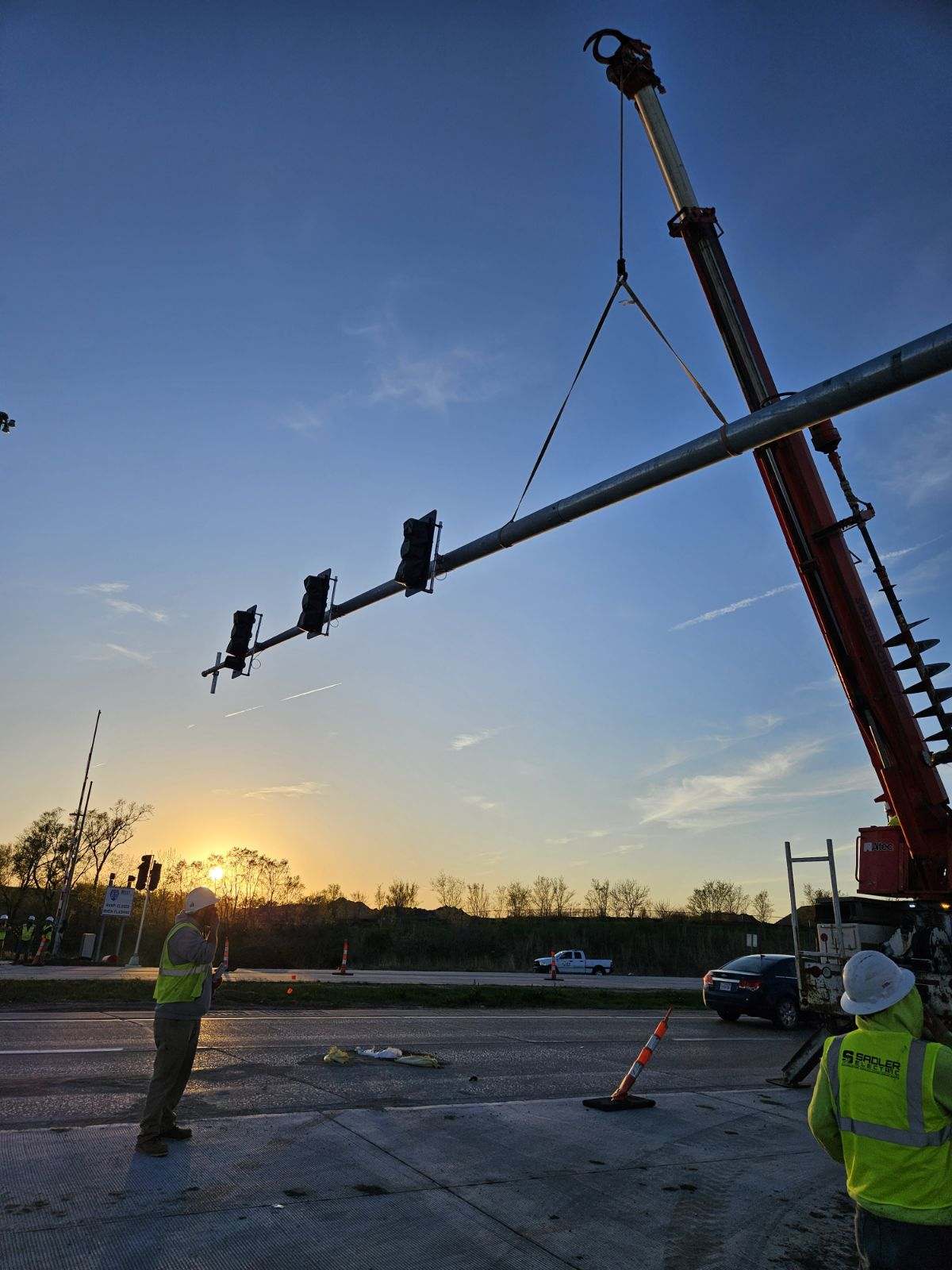
Pole erection requires a crane or boom truck of sufficient capacity for the pole weight plus the rigging load. Use the actual pole and mast-arm weights from the approved shop drawings and the crane lift plan. The crane sets the pole onto the anchor bolts, and the leveling nuts are set to plumb the pole before final nut torque.
Mast arm assembly may be performed on the ground before erection (the arm is bolted to the pole while the pole is horizontal, then the entire assembly is stood up) or the arm is attached to an already-erected pole using the crane. Which method is used depends on equipment capacity, site clearance, and pole design.
After erection, the signal heads and pedestrian equipment are mounted on the arm and wired. Signal head positions are governed by MUTCD placement requirements and agency standard drawings.
Controller Cabinet Setup and Programming
The controller cabinet is installed on a concrete pad adjacent to the intersection. Cabinet setup includes:
- Mounting the cabinet to the anchor bolts embedded in the pad
- Connecting the electrical service (utility service entrance)
- Installing and wiring the controller, conflict monitor, and phase load switches
- Running all conduit circuits into the cabinet and terminating conductors
Cabinet internal wiring is done to the signal plans and the controller's own wiring diagrams. All conductors are labeled by phase and circuit.
The signal timing plan is programmed into the controller before commissioning. On Nebraska DOT-owned signals, the timing plan is provided by the agency. On locally owned signals, the engineer of record or agency traffic engineering staff provides the initial timing plan; the contractor programs it per the agency's direction. Signal timings are inputted and subsequently adjusted by the jurisdiction that maintains ownership of the traffic signals.
Testing, Inspection, and Turn-Over
Before a new signal can be turned on, a formal acceptance inspection is conducted by the agency. The process typically includes:
Contractor pre-test. The contractor powers the signal and tests all phases, pedestrian equipment, detection, and cabinet functions against the approved design. Deficiencies are documented and corrected before the agency inspection.
Agency inspection. The DOT or city inspector witnesses a full operational test. All phases, pedestrian intervals, detection loops or video detection zones, cabinet alarms, and communications functions are verified. The inspector reviews wiring documentation, foundation records, and as-built drawings.
Traffic control timing. The actual signal turn-on must be coordinated with the agency traffic operations center. Signals on coordinated corridors must be timed to start the turn-on in conjunction with adjacent signals.
Punch list and closeout. Any remaining work items are documented and completed. Final documentation — as-built drawings, foundation records, wiring logs, concrete test results, and O&M manuals for the equipment — is submitted to the agency for the permanent project file.
How Long Does Traffic Signal Installation Take?
Total project duration from design approval to signal turn-on for the construction phase is typically 5 to 10 weeks for a standard new signal at a four-way intersection.
Construction duration for a standard four-way intersection:
- Underground conduit and pull box work: 2 to 4 weeks
- Drilled shaft installation
- Pole erection and equipment mounting
- Cabinet installation and wiring: 3 to 5 days
- Final testing and commissioning: 1 to 3 days
Complex intersections with extensive underground work, phased construction, or adaptive control integration can take longer. Total duration from warrant study to signal turn-on — including design, review, and permitting — is typically 12 to 24 months.
Traffic Signal Installation Costs
Traffic signal cost varies significantly with intersection size, site conditions, and agency specification level. The following ranges represent general market conditions for the Omaha metro as of 2025–2026 and are not project-specific estimates.
- Underground conduit and pull boxes (full intersection) — Typical Range: $60,000 – $130,000
- Drilled shaft foundations (4-corner intersection) — Typical Range: $50,000 – $100,000
- Signal poles and mast arms (materials) — Typical Range: $50,000 – $120,000
- Signal heads, pedestrian equipment, LEDs — Typical Range: $12,000 – $30,000
- Controller cabinet and signal controller — Typical Range: $18,000 – $35,000
- Electrical service — Typical Range: $3,000 – $15,000
- Pavement restoration — Typical Range: $10,000 – $40,000
- Engineering and inspection — Typical Range: $25,000 – $70,000
- Total — standard 4-way intersection — Typical Range: $250,000 – $500,000+
High-complexity intersections — adaptive control, CCTV, emergency preemption, fiber communications, transit signal priority — can exceed $600,000.
Traffic Signal Installation With Sadler Electric in Omaha and Council Bluffs
Sadler Electric, Inc. is a specialty infrastructure contractor serving the Omaha and Council Bluffs metro area. The company holds Electrical Contractor licensing, Journeyman Electricians, and IMSA certifications, with documented history across single-intersection projects and multi-intersection contracts of 50 or more intersections. The company works with Nebraska DOT, Iowa DOT, municipal, and general contractor clients throughout Douglas, Sarpy, and Pottawattamie Counties.
Sadler Electric also provides emergency, corrective, and support services on new and existing traffic signal systems as needed.
For project inquiries, general contractor partnerships, or maintenance support, contact Sadler Electric at (402) 331-3217 or through sadlerelectric.com.
FAQ: Traffic Signal Installation
What is involved in traffic signal installation?
Traffic signal installation includes underground conduit and pull box work, drilled shaft foundations for signal poles, pole erection and mast arm assembly, signal head and pedestrian equipment mounting, controller cabinet installation and wiring, electrical service connection, and final testing and turn-over to the agency. The work is performed by specialty contractors whose required licences, technician certifications and agency approvals are set by the governing contract and agency.
What components make up a traffic signal system?
The core components are: signal poles and mast arms, signal heads with LED modules, pedestrian signal units and accessible push buttons, the controller cabinet (including signal controller and conflict monitor), underground conduit and conductors, pull boxes, and the electrical service connection. See the Traffic Signal System Components section above for detail.
How much does it cost to install a traffic signal?
A standard four-way intersection signal runs approximately $250,000 to $500,000 total installed, including engineering, foundations, poles, underground work, equipment, and pavement restoration. High-complexity signals with adaptive control or CCTV can exceed $600,000. See the cost table above for component-level breakdowns.
How long does traffic signal installation take?
Field construction for a standard new signal typically takes 5 to 10 weeks. The construction phase covers underground conduit, drilled shaft installation, pole erection, cabinet wiring, and testing. Total time from design to turn-on (including permitting and agency review) is typically 12 to 24 months.
This guide provides general information about the traffic signal installation process in Nebraska and Iowa. Project-specific requirements vary by agency, intersection type, and site conditions. Contact a qualified specialty contractor or your state DOT for project-specific guidance.
Planning a Traffic Signal Project?
Sadler Electric installs traffic signals in the Omaha and Council Bluffs area. Call (402) 331-3217 or send us a message to talk through your project.