How Traffic Signal Timing Works: A Guide to Signal Timing and Control
By Sadler Electric, Inc. — Omaha & Council Bluffs Traffic Signal Contractors
Traffic signal timing is the set of rules that controls how a signal allocates green time among the competing movements at an intersection. Well-designed timing reduces delay, minimizes fuel consumption, lowers rear-end crash rates, and keeps traffic moving through a corridor. Poorly designed timing creates unnecessary stops, long queues, and driver frustration. Understanding how timing works helps agencies, developers, and project managers make better decisions about signal systems.
The Building Blocks of Signal Timing
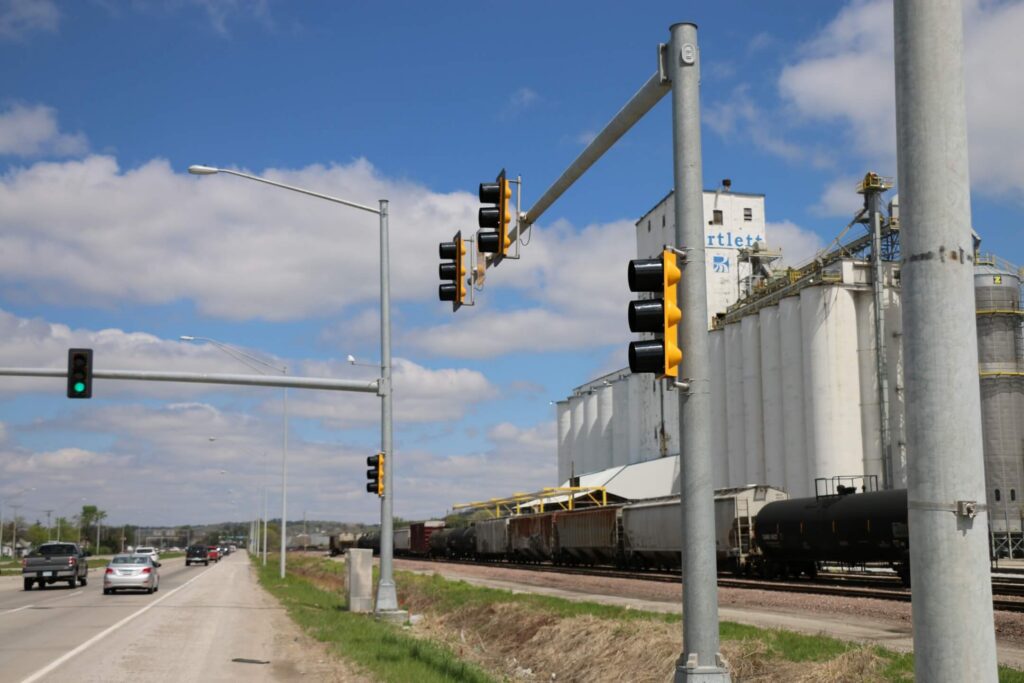
Phase. A phase is a period of green assigned to one or more compatible traffic movements. At a standard four-legged intersection, the most common configuration has two main-street phases (north-south through and right turn, east-west through and right turn) and two side-street phases, plus a pedestrian phase paired with each vehicular phase. Left-turn movements may be given their own protected phase or may share a phase with through traffic in a permitted or protected-permissive mode.
Cycle length. The cycle length is the total time — in seconds — for a signal to complete one full sequence of all phases before returning to the first phase. Typical cycle lengths range from 60 seconds at low-volume intersections to 150 seconds or more at heavily loaded urban intersections. Shorter cycles reduce average delay per vehicle; longer cycles can improve throughput at high-volume locations but increase wait time for minor movements.
Split. The split is the percentage of the cycle length allocated to each phase, or alternatively the number of seconds of green, yellow, and all-red assigned to each phase. Splits are engineered based on the volume of vehicles in each movement, the saturation flow rate of each lane group, and the minimum phase times required for pedestrian crossing.
Offset. In a coordinated corridor — a sequence of signals set to move platoons of vehicles through multiple intersections with minimal stops — offset is the time relationship between the start of the main phase at one signal and the start of the main phase at the next. Setting offsets correctly is the foundation of signal coordination ("green wave").
Time-of-Day and Plan Switching
Most modern traffic signal controllers allow multiple timing plans, each optimized for a different time period. A typical installation has four to eight plans: AM peak, midday, PM peak, evening, overnight, and a weekend plan. The controller switches between plans on a calendar schedule.
Time-of-day plan switching is a significant improvement over fixed single-plan operation. An intersection that serves a school zone during morning dropoff and an office district during midday has very different traffic demand patterns at those two periods. A single timing plan that is a compromise between the two performs poorly at both times.
Actuated Control and Vehicle Detection
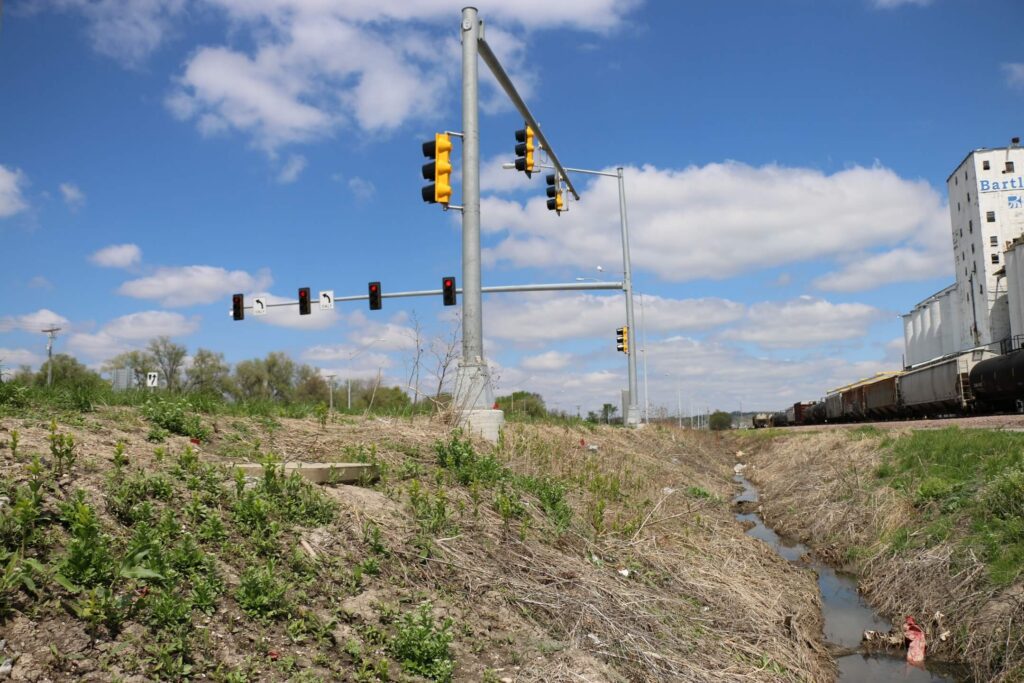
A fully actuated signal uses vehicle detection — typically inductive loops in the pavement or video/radar detection above ground — to measure demand on each phase and adjust green time in real time. Rather than running a fixed split, the controller extends a phase as long as vehicles are present (up to a maximum green) and terminates it early when no vehicles are detected.
Actuated control reduces cycle length and total delay at intersections with uneven or fluctuating demand. It is specified for new signal installations in Nebraska and Iowa under state DOT specifications.
The detection system is a critical part of actuated control. A failed loop detector that does not detect approaching vehicles will cause the associated phase to be skipped, producing a signal that appears to ignore vehicles waiting in that lane. Detection maintenance is inseparable from signal timing performance.
Adaptive Signal Control
Adaptive signal control systems — deployed in interconnected corridors — use real-time traffic data to continuously update timing plans across multiple intersections simultaneously, rather than switching between a finite set of pre-programmed plans. Adaptive systems can respond to incidents, events, and unusual traffic patterns without manual intervention.
Nebraska DOT and some larger Midwestern municipalities have deployed adaptive signal control on priority corridors. These systems depend on reliable communication between intersections, compatible controller hardware, and a central software platform. Fiber is the most common communication method on those corridors, though it is not the only one.
Controller Software: What Actually Runs the Intersection
There is an important distinction that often gets blurred. Design and modeling software is used before an intersection is built, to plan geometry and test proposed timing. Controller software is what runs locally on the intersection hardware after it is built, managing phase timing and coordination; some platforms also support connected-vehicle functions. They are different products from different vendors, and the results of a design-stage analysis have to be translated and configured into the field controller before they affect a single driver.
Examples of controller and traffic-management platforms include:
- Q-Free MAXTIME ic — Linux-based local intersection control software with a built-in web server, so operations and management run through a standard browser with no specialized software on the laptop.
- Econolite OASIS — legacy controller software used with 2070-type controllers.
- Econolite EOS — Advanced Transportation Controller (ATC) software developed for the Cobalt series and other properly configured ATC controllers, supporting adaptive operation and connected and automated vehicle (CAV) applications.
- Yunex Traffic SEPAC — controller firmware with a 16-line menu interface, supporting vehicle-to-infrastructure (V2I) and Signal Phase and Timing (SPaT) data.
- Fourth Dimension Traffic D4 — used for transit signal priority and advanced coordination across 2070 and NEMA ATC controllers.
- SWARCO McCain MyCity Suite — a central traffic-management platform rather than local controller software, covering MyCity TMS, adaptive control, and Signal Performance Measures (SPM) for corridor-level adjustments.
Most of these are not software alone — they are a mixture of software and the controller hardware it runs on. Because the signals are owned by the jurisdiction, the platform at any given intersection is the one the owning agency has specified, not one the installing contractor selects.
Pedestrian Timing Requirements
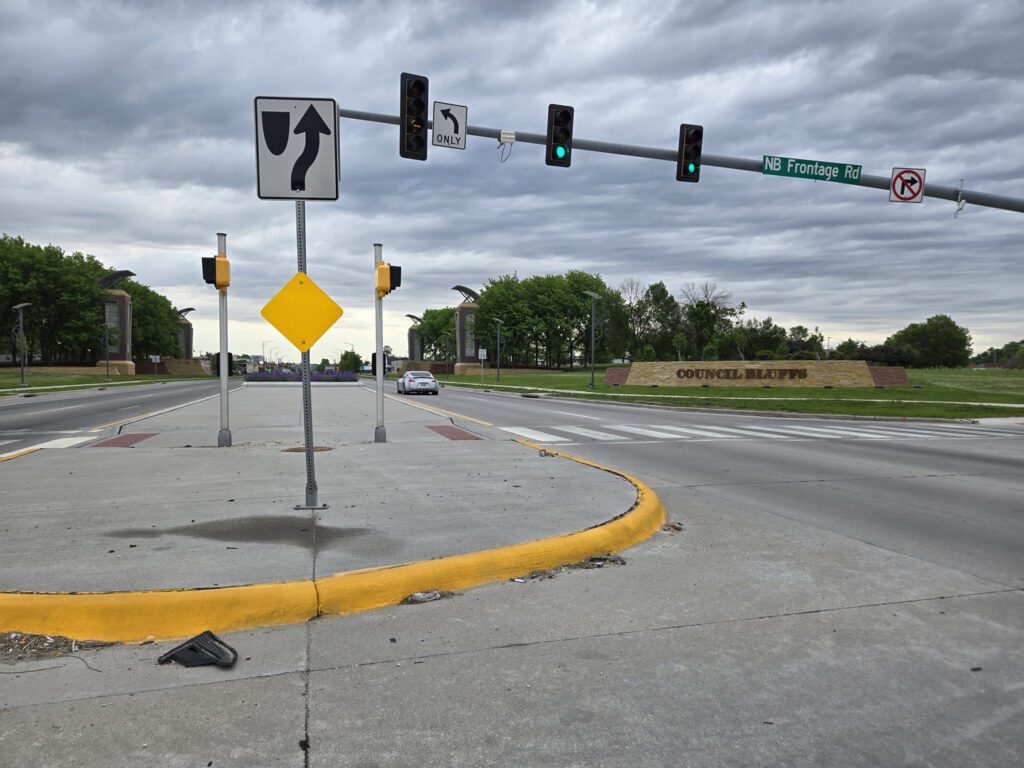
Traffic signal timing must accommodate pedestrians as a primary design constraint, not an afterthought. The MUTCD (Manual on Uniform Traffic Control Devices) sets pedestrian interval requirements based on crossing distance and walking speed, and it uses two different speeds for two different calculations:
- 3.5 feet per second to set the pedestrian clearance time — the time allowed for someone who steps off the curb at the very end of the WALK indication to finish crossing.
- 3 feet per second for the total of the walk interval plus the pedestrian clearance time, which is the check that the full crossing can be made comfortably.
The MUTCD also directs that pedestrians who walk slower than 3.5 feet per second be considered where their presence is significant, which is handled through measures such as a longer walk interval or extended pushbutton press functions rather than a single substitute speed.
Accessible pedestrian signals (APS) provide the walk indication in audible and vibrotactile form along with a pushbutton locator tone, so that the crossing information available to a sighted pedestrian is available to one who is blind or has low vision. Where APS are installed, the MUTCD governs how they are to be placed and operated. Agencies should confirm current accessibility obligations for a given project with their own counsel and the governing agency, since federal accessibility rulemaking for pedestrian facilities has continued to develop.
Signal Timing and Corridor Performance
Signal timing has a direct and measurable effect on corridor performance. Signal retiming is consistently one of the lowest-cost ways to improve an arterial corridor, and agencies undertake it precisely because the travel-time and fuel savings are measurable. The size of the gain depends entirely on the corridor and on how poor the existing timing was, so a single headline percentage is not meaningful without the study behind it. Smoothing flow and reducing abrupt stops can also reduce rear-end conflicts.
Traffic engineers typically evaluate signal timing performance using measures of effectiveness (MOEs) such as average delay per vehicle (measured in seconds per vehicle), stops per vehicle, and queue length.
Traffic simulation packages such as Synchro, VISSIM, and PTV VISTRO are used at the design and modeling stage — before an intersection is built, and when an agency is evaluating a proposed timing change. These are engineering analysis tools, not the software that operates the signal. Once the intersection is in service, the results of that analysis are imported or configured into the controller software described above.
Traffic Signal Contractors in Omaha and Council Bluffs
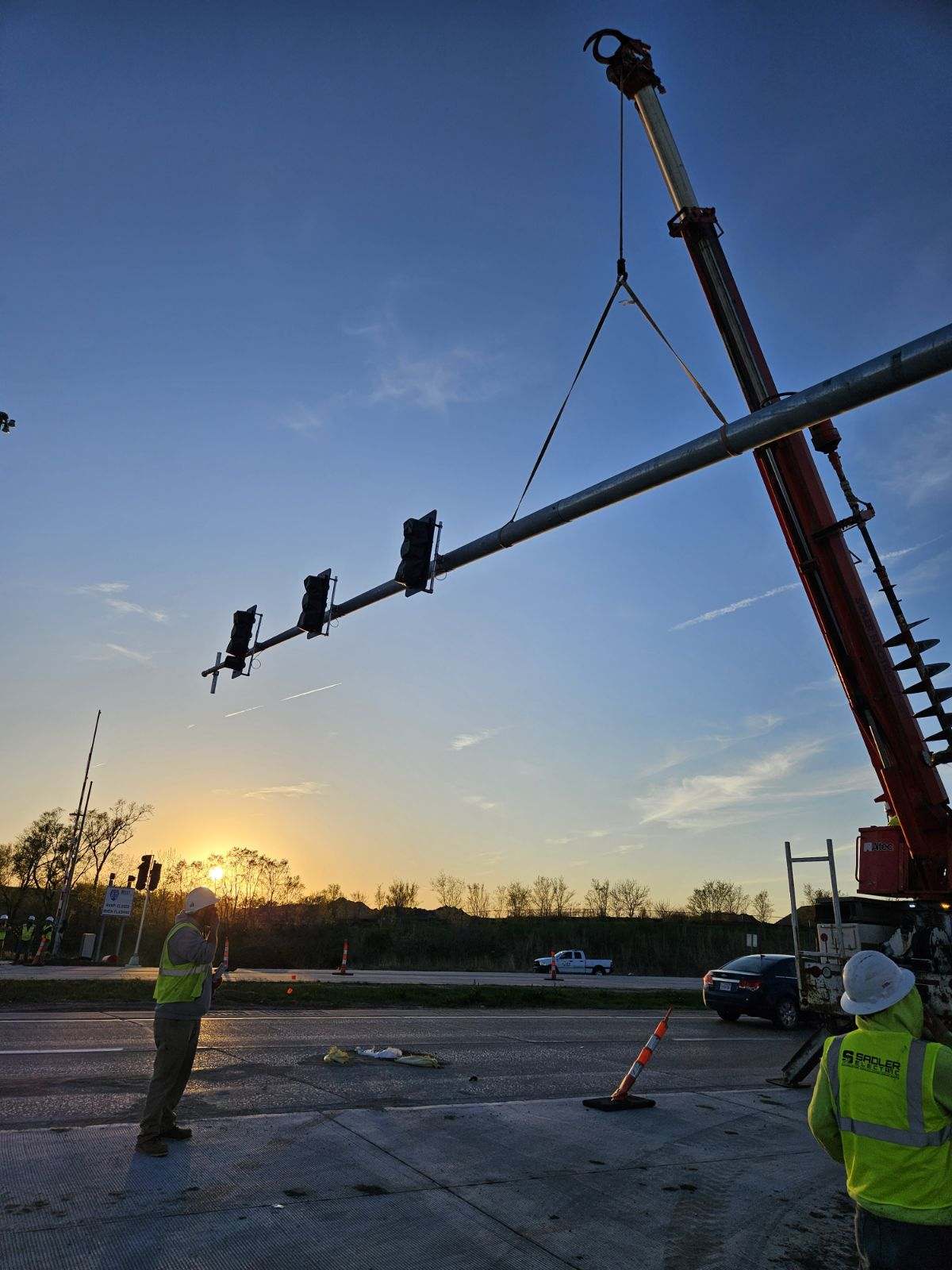
Sadler Electric, Inc. installs and maintains traffic signal systems in Omaha, Council Bluffs, and the surrounding 50-mile service area. The company works with state DOT agencies, municipalities, and general contractors on signal installation, drilled shaft foundations, and controller programming for both new installations and signal upgrades. Signal timings are inputted and adjusted by the jurisdiction maintaining ownership of the traffic signals. Engineers provide initial signal timings, which are monitored and adjusted based on actual vehicle interaction with the intersection and as volume changes. When directed by the owning agency, Sadler installs and programs the controller using the agency-provided timing plan, on whichever controller platform that agency has specified for the intersection. Programming here means entering the agency-approved plan; Sadler does not select the timing or change it independently. Contact Sadler Electric at (402) 331-3217 or sadlerelectric.com.
This article provides general information on traffic signal timing principles. Signal timing design should be performed by a licensed traffic engineer familiar with local DOT specifications and current MUTCD requirements.
Planning a Traffic Signal Project?
Sadler Electric installs traffic signals in the Omaha and Council Bluffs area. Call (402) 331-3217 or send us a message to talk through your project.